CHAPTER 5
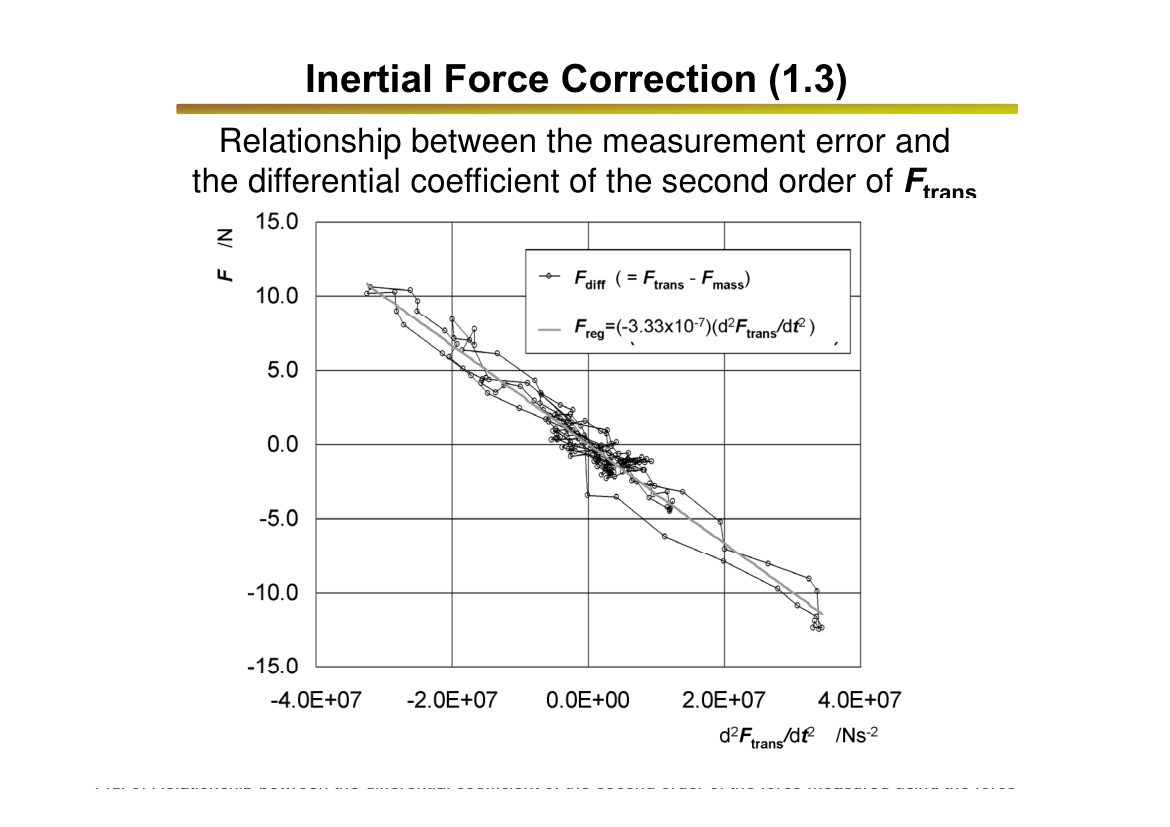
Detailed measurement of a force transducer's electrical and mechanical responses to impact forces showed that the difference between the transducer value and the LMM reference (the dynamic error) is well explained as the inertial force of the transducer's own sensing element. This inertial force is almost proportional to the acceleration of the sensing point, a2. Since the deformation of the transducer is almost proportional to the force, a2 is thought to be proportional to the second derivative of the output, d²Ftrans/dt².
Figure: Relationship between the measurement error and the second derivative of the transducer output
So the dynamic error can be corrected from the sensor output alone, without an external reference, by adding the second derivative of the output multiplied by a coefficient. The correction was shown to reduce the root-mean-square (RMS) error substantially.
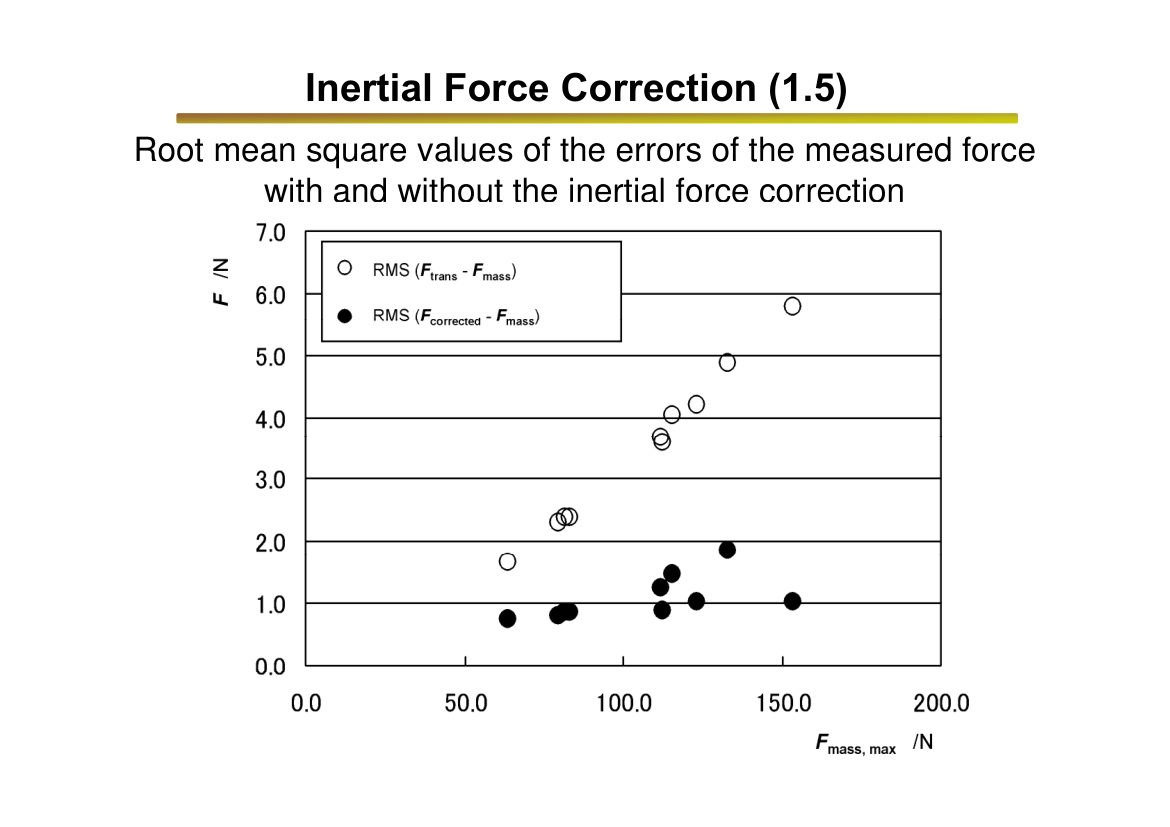
Figure: RMS errors of the measured force with and without inertial force correction
Software was developed that takes the waveform from the transducer, amplifier and ADC, and outputs the corrected waveform and its uncertainty. The first prototype assumes the transducer is firmly attached to a stable base.
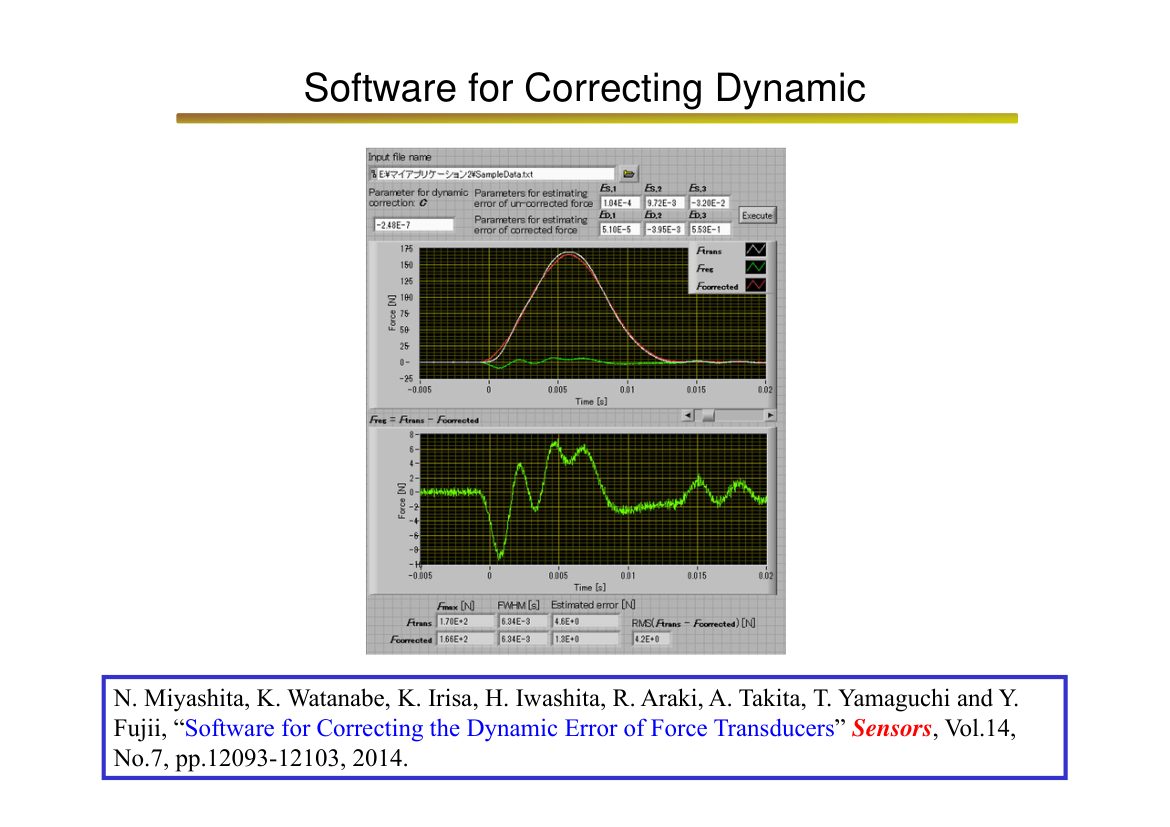
Figure: Software for correcting the dynamic error of force transducers (Sensors, 2014)
|
Towards Dynamic Calibration of Force Transducers: Self Error Correction Using the Second Derivative of Sensor Output Role: Self error correction by the second derivative, towards dynamic calibration of force transducers Discusses, towards establishing dynamic calibration of force transducers, a self-correction method that corrects a transducer's own dynamic error using the second derivative of its output. |
← Previous: 4. Dynamic Calibration | Next: 6. Air-Bearing Friction →
The Levitation Mass Method: precision force measurement by the definition of force | Yusaku Fujii (Gunma University)