Home | Contents | 日本語
CHAPTER 4
Dynamic Calibration of Force Transducers
The levitated mass is made to collide with a force transducer, and the inertial force of the mass (the reference force) is compared with the transducer output. This evaluates the transducer's response to time-varying forces.
Impact force
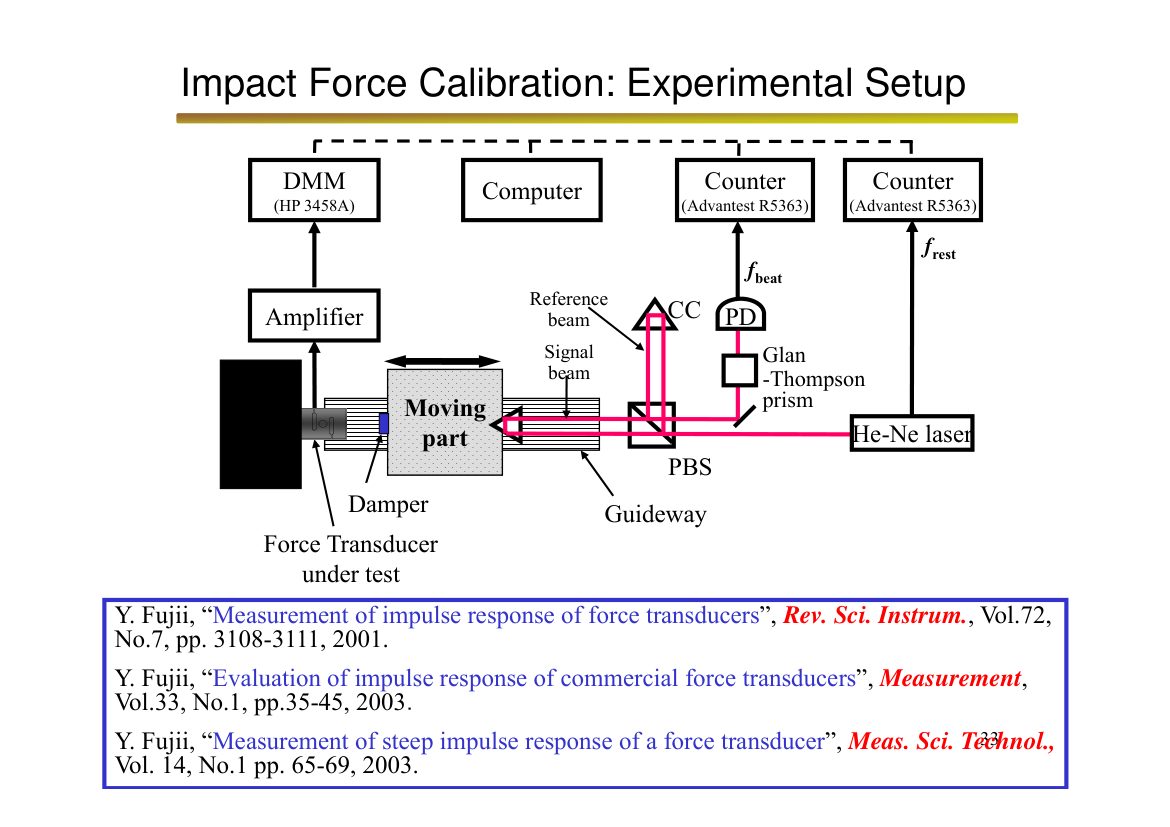
Figure: Experimental setup for impact force calibration
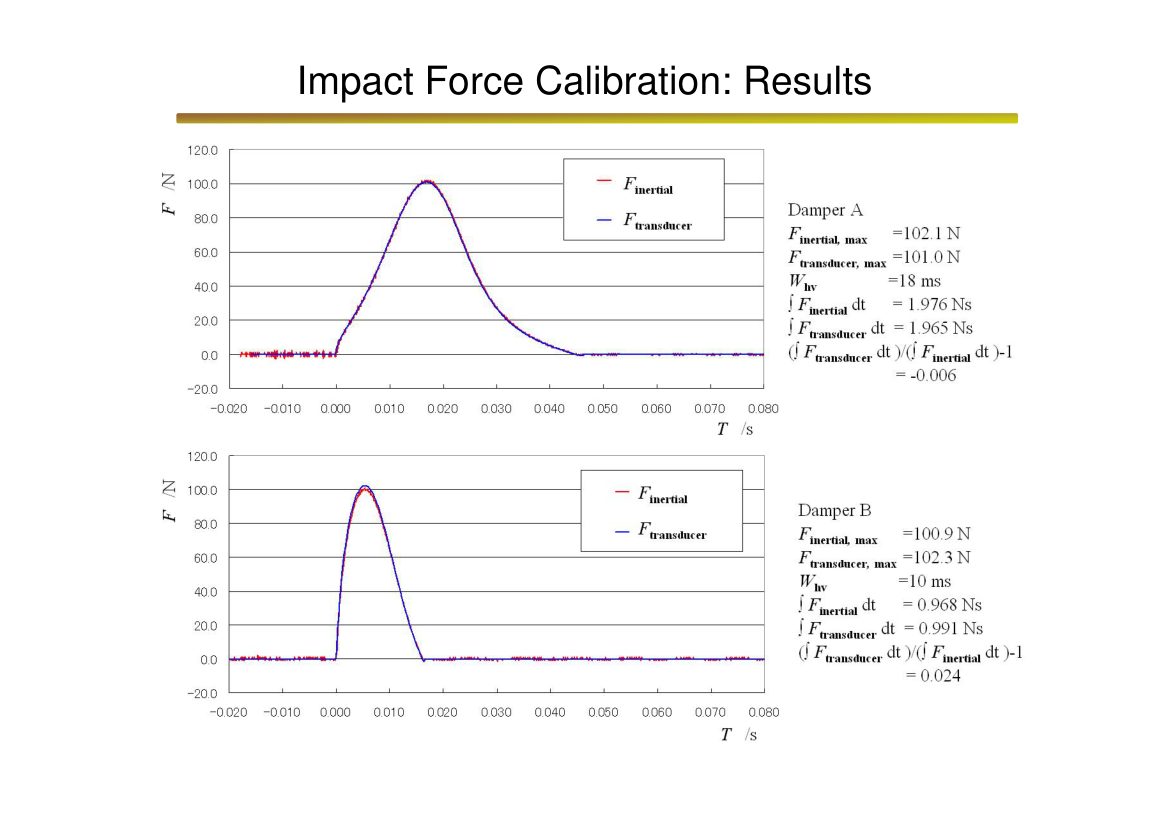
Figure: Results of impact force calibration, comparing the inertial force of the levitated mass with the transducer output
- Y. Fujii, H. Fujimoto, "Proposal for an impulse response evaluation method for force transducers", Meas. Sci. Technol., Vol.10, No.4, pp.N31–N33, 1999.
- Y. Fujii, "Measurement of impulse response of force transducers", Rev. Sci. Instrum., Vol.72, No.7, pp.3108–3111, 2001.
- Y. Fujii, "Measurement of steep impulse response of a force transducer", Meas. Sci. Technol., Vol.14, No.1, pp.65–69, 2003.
- Y. Fujii, "Evaluation of impulse response of commercial force transducers", Measurement, Vol.33, No.1, pp.35–45, 2003.
Oscillation force
A spring makes the mass oscillate, and the transducer's response to an oscillating force is evaluated.
- Y. Fujii, "A method for calibrating force transducers against oscillation force", Meas. Sci. Technol., Vol.14, No.8, pp.1259–1264, 2003.
Step force
A step force is applied, for example by letting the mass fall freely onto the transducer. From Ma = −Mg + Fmass, the force is Fmass = Ma + Mg.
- Y. Fujii, "Proposal for a step response evaluation method for force transducers", Meas. Sci. Technol., Vol.14, No.10, pp.1741–1746, 2003.
Torque transducers
- Y. Fujii, K. Ogushi, T. Tojo, "A proposal for a dynamic-response-evaluation method for torque transducers", Meas. Sci. Technol., Vol.10, No.12, pp.N142–N144, 1999.
← Previous: 3. Space Balance | Next: 5. Dynamic Error Correction →
Contents
The Levitation Mass Method: precision force measurement by the definition of force | Yusaku Fujii (Gunma University)