CHAPTER 1
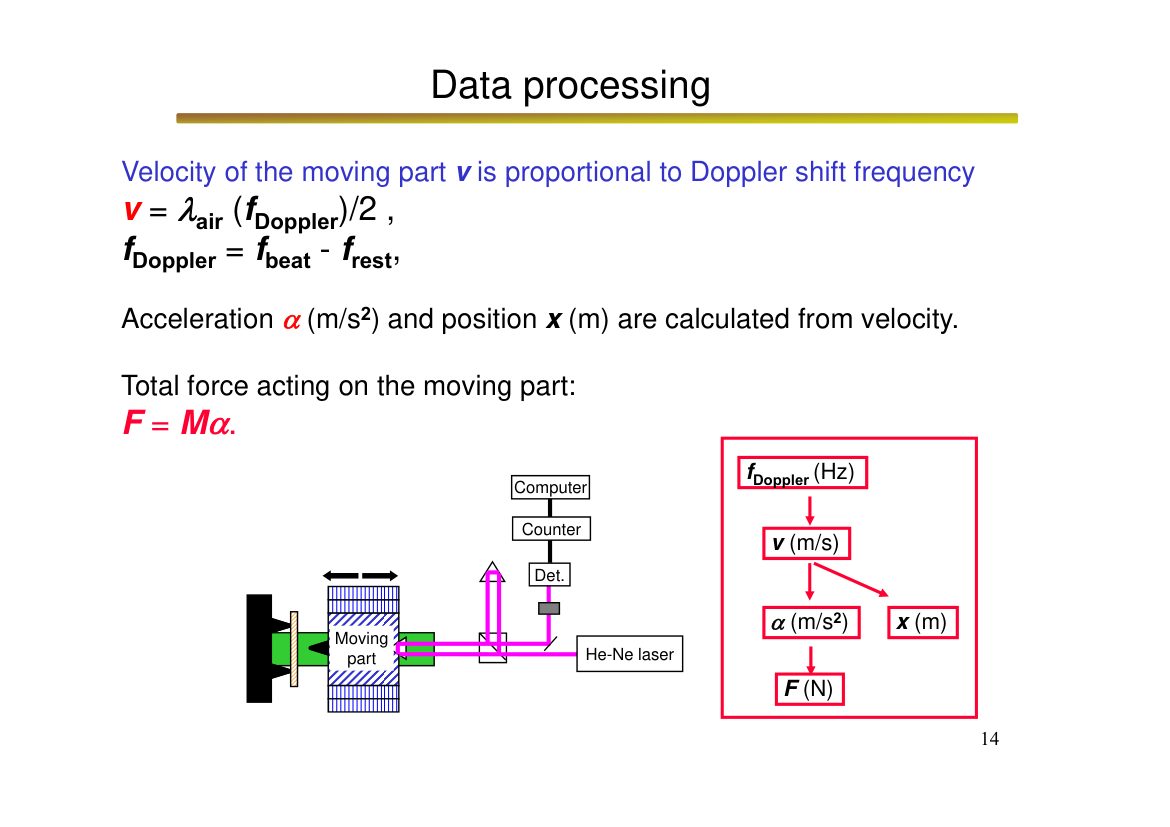
Figure: Data processing: frequency → velocity → acceleration and position → force
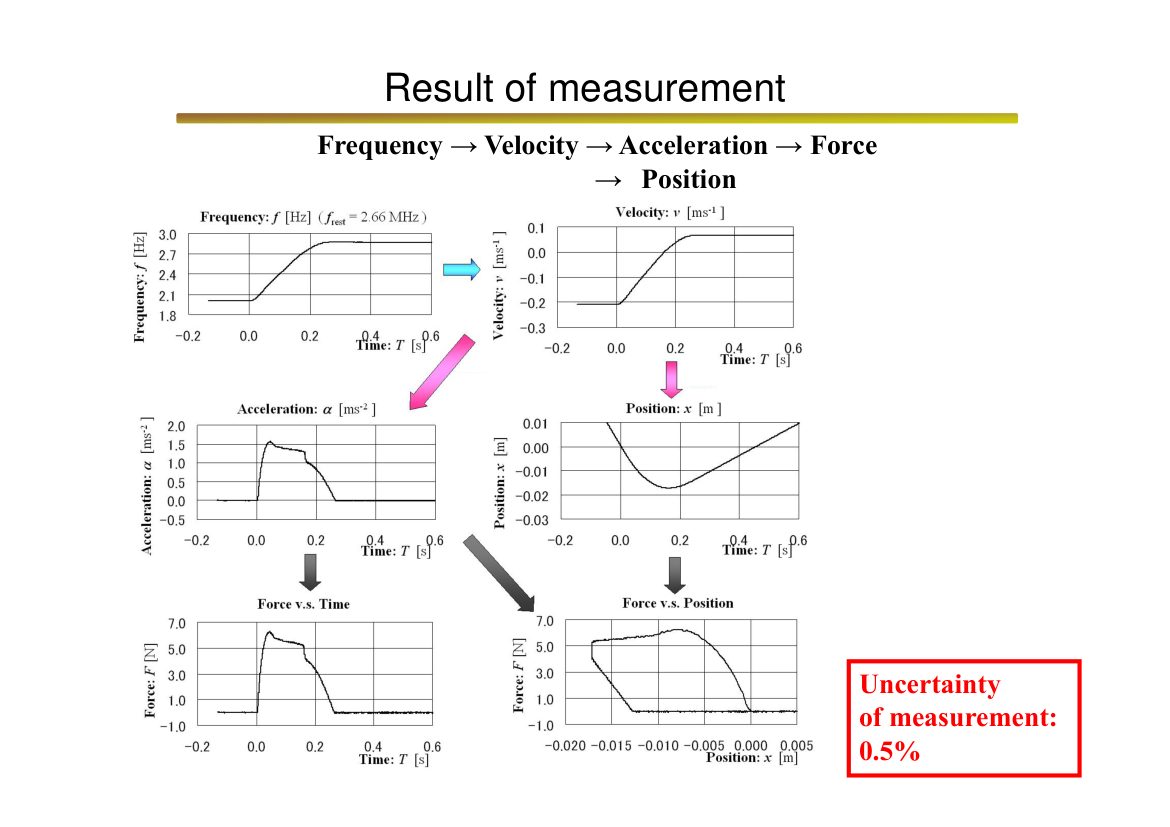
Figure: Example result. Velocity, acceleration, force and position are derived in turn from frequency (uncertainty about 0.5%)
| Strength | What it means |
|---|---|
| Based on the definition | Force is obtained directly from its definition as mass times acceleration. Mass can be measured precisely, and acceleration is traceable to the wavelength of light |
| Synchronised time axis | Only frequency is recorded during measurement; everything else is calculated afterwards, so velocity, position, acceleration and force share exactly the same time axis |
| No force transducer needed | The reference force does not rely on a force transducer, so force transducers themselves can be calibrated |
| Area | Targets | Chapter |
|---|---|---|
| Dynamic calibration of force transducers | Impact, oscillation and step forces; mechanical response | Ch. 4, Ch. 5 |
| Material tester without force transducers | Micro-force, viscoelasticity, friction, biomechanics | Ch. 7, Ch. 8 |
| Space balance | Mass measurement under weightless conditions | Ch. 3 |
← Previous: Home | Next: 2. Why It Is Needed →
The Levitation Mass Method: precision force measurement by the definition of force | Yusaku Fujii (Gunma University)