CHAPTER 3
The starting point of the LMM was research on a "space balance" (Space Scale) for measuring mass in weightless environments such as the International Space Station (ISS). Under weightlessness weight cannot be measured, so mass must be obtained from inertia. Body mass measurement is a medical requirement for ISS crew.
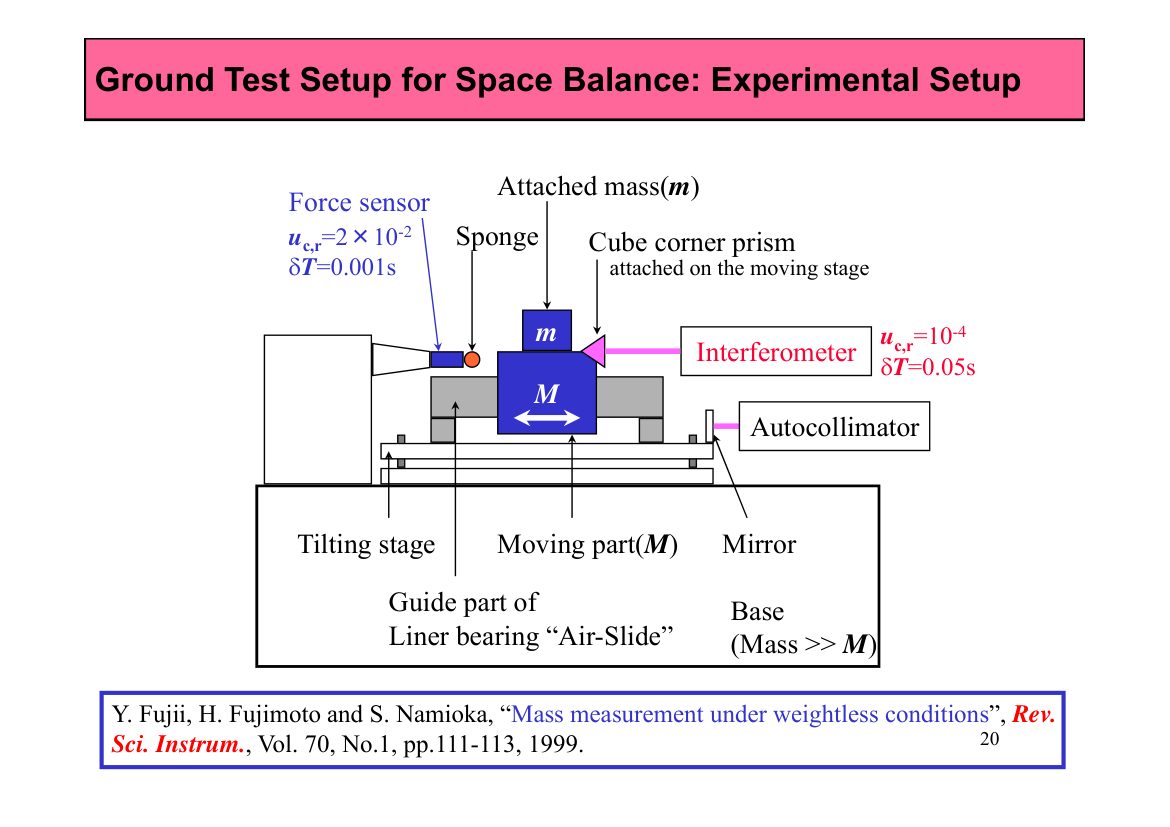
A mass M levitated on an air bearing collides with a base; the impulse on the base ∫Fdt and the velocities before and after the collision, v1 and v2, are measured. Mass follows from ∫Fdt = M(v1 − v2).
Figure: Ground test setup for the space balance (Rev. Sci. Instrum., 1999)
The instrument is held to the astronaut's body by a belt and connected through a bungee cord and a force transducer; mass is obtained from force and acceleration as m = F/α. A ground model achieved a precision of 1.6% rms and an accuracy of 0.4%, promising to meet body mass measurement requirements. Tests were carried out on parabolic flights from Nagoya (Gulfstream II, roughly 20 seconds of microgravity per parabola).
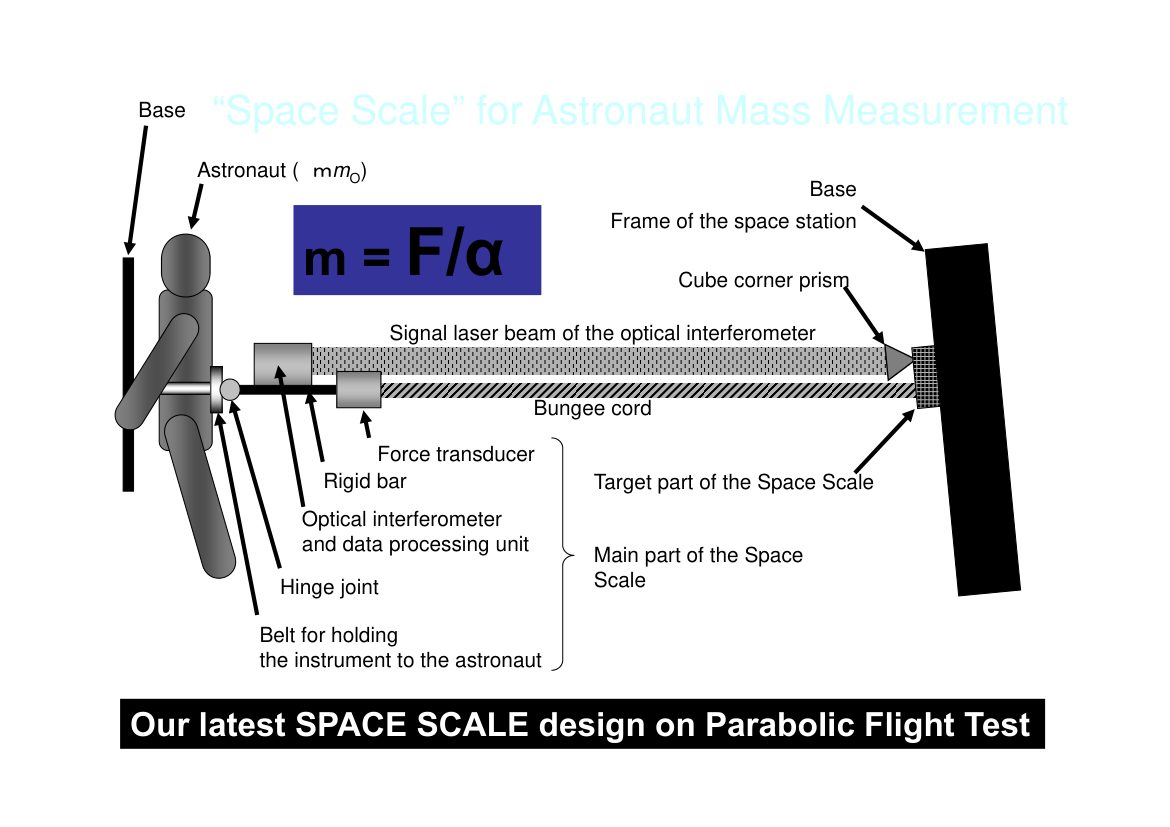
Figure: Latest space scale design for the parabolic flight test
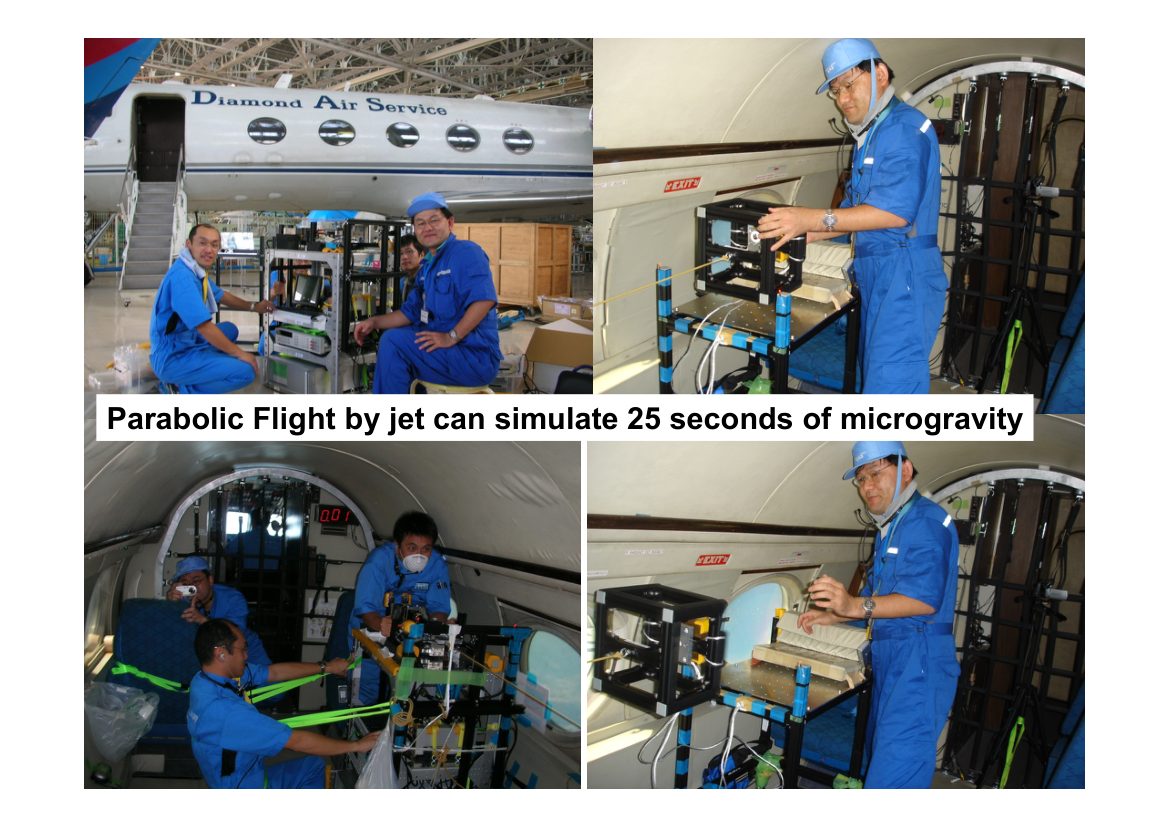
Figure: Microgravity testing on a parabolic flight
Building the ground test setup raised two questions: how do we know the uncertainty of the force, and how do we know the friction of the air bearing? The first led to dynamic calibration of force transducers (Chapter 4), the second to friction measurement of air bearings (Chapter 6), and both then grew into material testing (Chapter 7).
← Previous: 2. Why It Is Needed | Next: 4. Dynamic Calibration →
The Levitation Mass Method: precision force measurement by the definition of force | Yusaku Fujii (Gunma University)