日本語
The Levitation Mass Method
Measuring force by its definition.
The Levitation Mass Method (LMM) is a precision force measurement method proposed by the author. A force is applied to a mass M levitated with almost no friction by an air bearing, and the motion of the mass is measured with a laser interferometer. The force F is obtained from the very definition of force, the product of mass and acceleration, F = Ma. Its greatest strength is that time-varying forces can be measured without a force transducer.
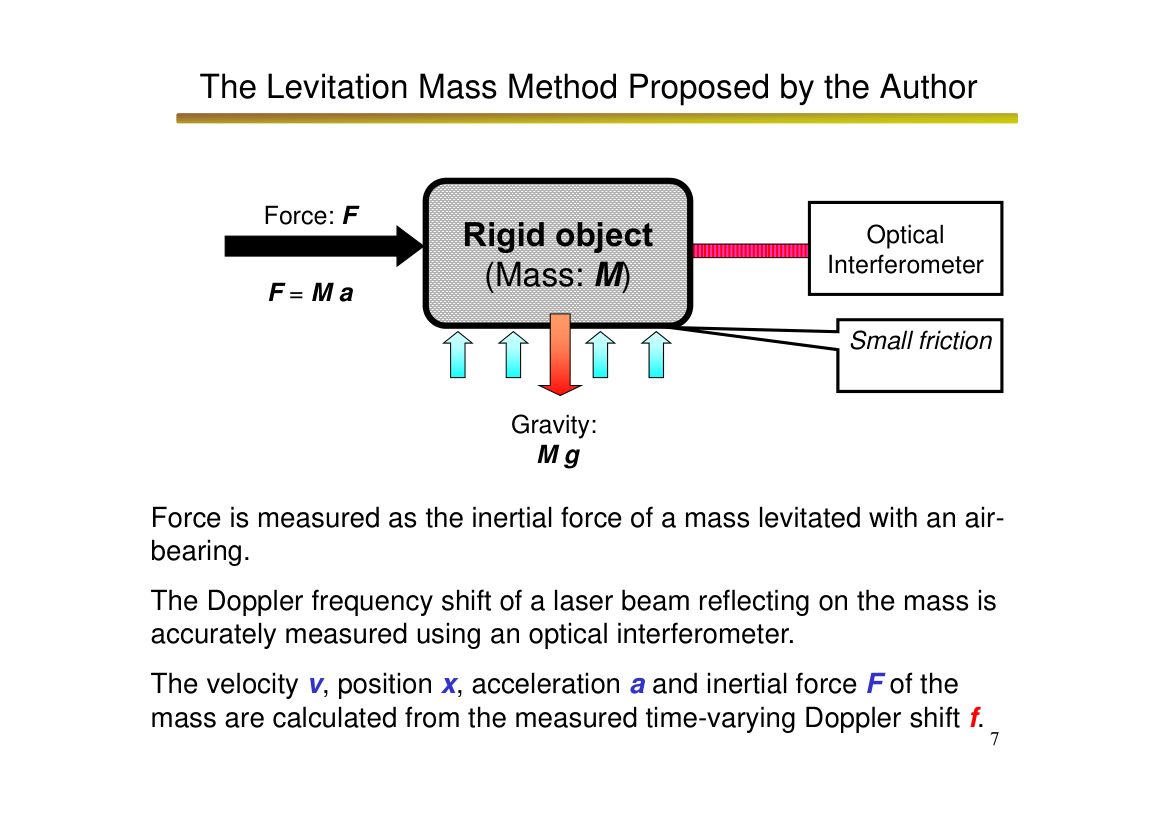
Figure: Principle of the LMM. A force F is applied to a rigid object (mass M) levitated by an air bearing, and its motion is measured with an optical interferometer
Key points
- Force from its definition. Force is the product of mass and acceleration; the inertial force of the levitated mass serves directly as the reference force.
- Only frequency is measured. During measurement, only the motion-induced Doppler-shift frequency of the laser beam is recorded. Velocity, position, acceleration and force are calculated numerically afterwards, so all quantities are precisely synchronised.
- Filling the gap in dynamic calibration. No method had been established for calibrating force transducers against time-varying forces. The LMM supplies impact, oscillation and step reference forces.
- Born from space. The starting point was a ground test setup for a "space balance" that measures mass under weightless conditions.
- The calibration setup becomes a material tester. Replace the transducer with a material and you have a tester that uses neither a force transducer nor a position sensor, for micro-forces, viscoelasticity, friction, and even the response of human fingers and arms.
- Still evolving. Self-correction of dynamic error using the second derivative of sensor output (2025) and noise-robust frequency estimation (2026).
| F = Ma | Measurement based on the definition of force itself |
| About 0.5% | Example uncertainty of impact force measurement (early setup) |
| 40+ | Peer-reviewed papers on the LMM (Meas. Sci. Technol., Rev. Sci. Instrum., IEEE Trans. Instrum. Meas. and others) |
| Since 1999 | From the first paper (mass measurement under weightless conditions) to the present |
Where to start
Contents
Next: 1. Principle →
The Levitation Mass Method: precision force measurement by the definition of force | Yusaku Fujii (Gunma University)