Home | Contents | 日本語
CHAPTER 7
A Material Tester Without Force Transducers
It is very difficult to evaluate the uncertainty of forces measured by transducers built into material testers, because dynamic calibration methods have not been established. Can the dynamic calibration setup be used for material testing? Yes. Replace the transducer under test with a material, and the same setup evaluates the material's mechanical properties. The tester measures only the Doppler-shift frequency and uses neither a force transducer nor a position sensor.
Micro-force
A moving part of 21.17 g was made to collide repeatedly with a material, generating and measuring forces at the micro- to milli-newton level. The effect of dynamic friction inside the bearing can also be seen in the change of velocity during free travel.
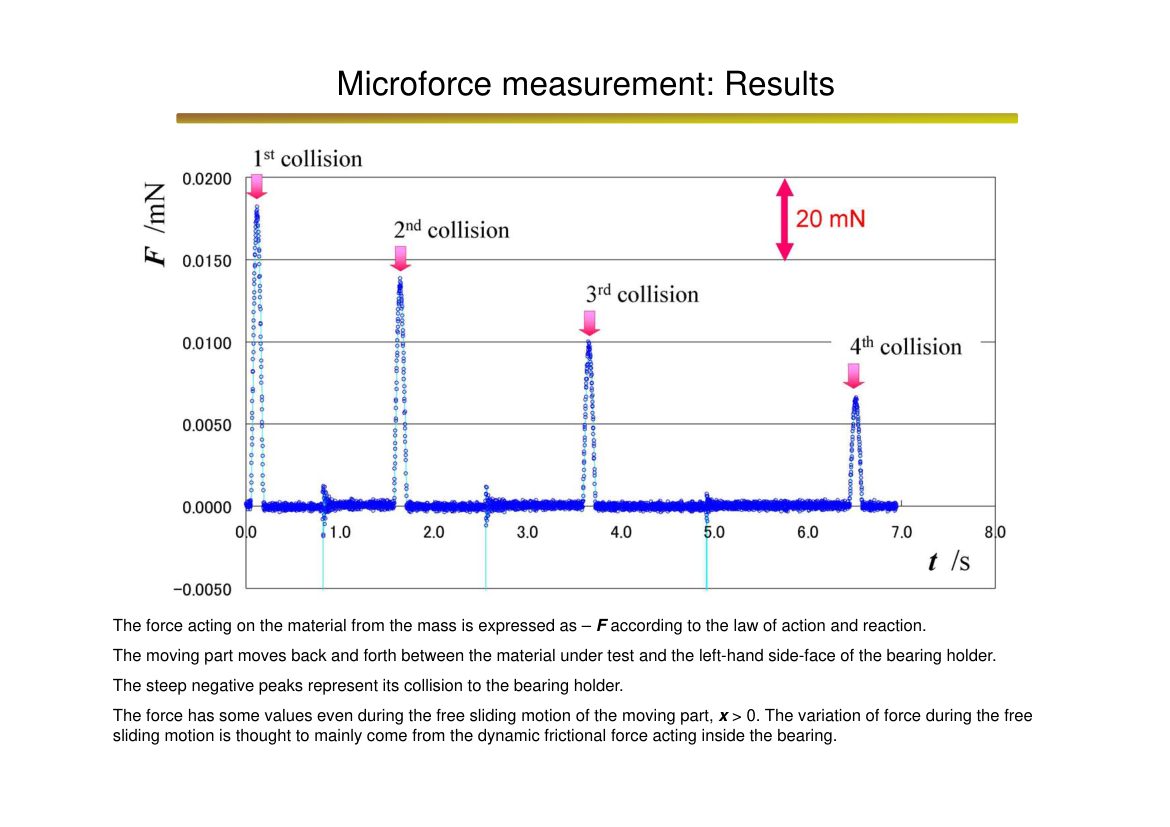
Figure: Micro-force measurement: force during four collisions of the moving part with the material
- Y. Fujii, "Microforce materials tester", Rev. Sci. Instrum., Vol.76, No.6, 065111, 2005.
- Y. Fujii, "Method for generating and measuring the micro-Newton level forces", Mech. Syst. Signal Process., Vol.20, No.6, pp.1362–1371, 2006.
- Y. Fujii, "Microforce materials tester based on the levitation mass method", Meas. Sci. Technol., Vol.18, No.6, pp.1678–1682, 2007.
- Y. Fujii, "Method of generating and measuring static small force using down-slope component of gravity", Rev. Sci. Instrum., Vol.78, No.6, 066104, 2007.
- Y. Fujii, D.W. Shu, "Impact force measurement of an actuator arm of a hard disk drive", Int. J. Impact Eng., Vol.35, No.2, pp.98–108, 2008.
Viscoelasticity
Impact and oscillation loads are applied to evaluate material viscoelasticity.
- Y. Fujii, T. Yamaguchi, "Method for evaluating material viscoelasticity", Rev. Sci. Instrum., Vol.75, No.1, pp.119–123, 2004.
- Y. Fujii, T. Yamaguchi, "Proposal for material viscoelasticity evaluation method under impact load", J. Mater. Sci., Vol.40, No.18, pp.4785–4790, 2005.
- Y. Fujii, "Method of evaluating the dynamic response of materials to forced oscillation", Meas. Sci. Technol., Vol.17, No.7, pp.1935–1940, 2006.
Friction
Transient friction coefficients, for example of rubber wiper blades on glass, were measured.
- Y. Fujii, T. Yamaguchi, "Optical method for evaluating material friction", Meas. Sci. Technol., Vol.15, No.10, pp.1971–1976, 2004.
- Y. Fujii, "Method for measuring transient friction coefficients for rubber wiper blades on glass surface", Tribol. Int., Vol.41, No.1, pp.17–23, 2008.
Crash and bending
Applied to determining impact force in crash testing and to dynamic three-point bending tests of pure aluminium wire.
- Y. Fujii, D. Isobe, S. Saito, H. Fujimoto, Y. Miki, "A method for determining the impact force in crash testing", Mech. Syst. Signal Process., Vol.14, No.6, pp.959–965, 2000.
- Y. Fujii, "Dynamic three-point bending tester using inertial mass and optical interferometer", Opt. Lasers Eng., Vol.38, No.5, pp.305–318, 2002.
← Previous: 6. Air-Bearing Friction | Next: 8. Biomechanics and Impact →
Contents
The Levitation Mass Method: precision force measurement by the definition of force | Yusaku Fujii (Gunma University)