Home | Contents | 日本語
CHAPTER 11
Research History
FMPS + VRAIO did not appear out of nowhere. It is the result of more than 20 years of research, begun in 2002, on community watching-over and on mechanisms to prevent its misuse.
Timeline
- 2002 The e-JIKEI Network concept: ordinary households watch over the public space in front of their homes using common PCs and inexpensive cameras — not for themselves, but for the safety of the community.
- 2004–2005 Community-security software for PCs distributed free of charge. From 2005, a community trial with 30 cameras at 20 homes in a district of about 300 households in Maebashi City.
- Later From home cameras to many inexpensive stand-alone cameras, encrypted recording, and systems suited to organised introduction by municipalities.
- In parallel Research on privacy protection, covering not only unauthorised access from outside but also misuse by legitimate administrators: encryption, access control, disclosure of camera operating status, and complete recording of viewing history.
- 2009 Announcement of the "e-JIKEI Light", an LED security light with a built-in camera, jointly developed by four parties: the NPO e-JIKEI Network Promotion Institute, TOSTEC Co., Ltd., ROCKY Co., Ltd. and the Faculty of Engineering, Gunma University. An all-in-one design needing no PC, it runs on the security light's power supply and stores about the last week of images, encrypted, on a built-in memory card. Decryption requires a release password and a PC with dedicated software. The expected retail price was ¥50,000–70,000, comparable to the cost of installing a security light alone. TOSTEC went on to manufacture and sell it, and later independently developed and now sells a second-generation model.
- Later Field trials of the e-JIKEI Net Camera in Kiryu City. Footage is stored encrypted in each camera, viewing requires a permission code issued by a recording server, and every viewing is made public — the prototype of VRAIO, implemented as a working system.
- 2016 Explicit proposal that every streetlight may come to have network cameras.
- AI era VRAIO. The long-standing concern with accountable use of information develops into a mechanism governing for what purpose, and under what auditable rules, information generated by AI may leave a system.
- 2026 Publication of a paper combining FMPS and VRAIO and examining social acceptance, with coverage density and continuous tracking as central design requirements.
Field trials and demonstrations
Field trials of the e-JIKEI Net Camera were carried out in Kiryu City, Gunma Prefecture, at a monthly car park, tenant buildings, homes and a welfare facility. The system works as follows:
- Footage is stored encrypted inside each camera.
- Viewing footage requires a permission code issued by the recording server.
- The recording server records the viewer, camera, image file and time of issue, and makes the viewing record public.
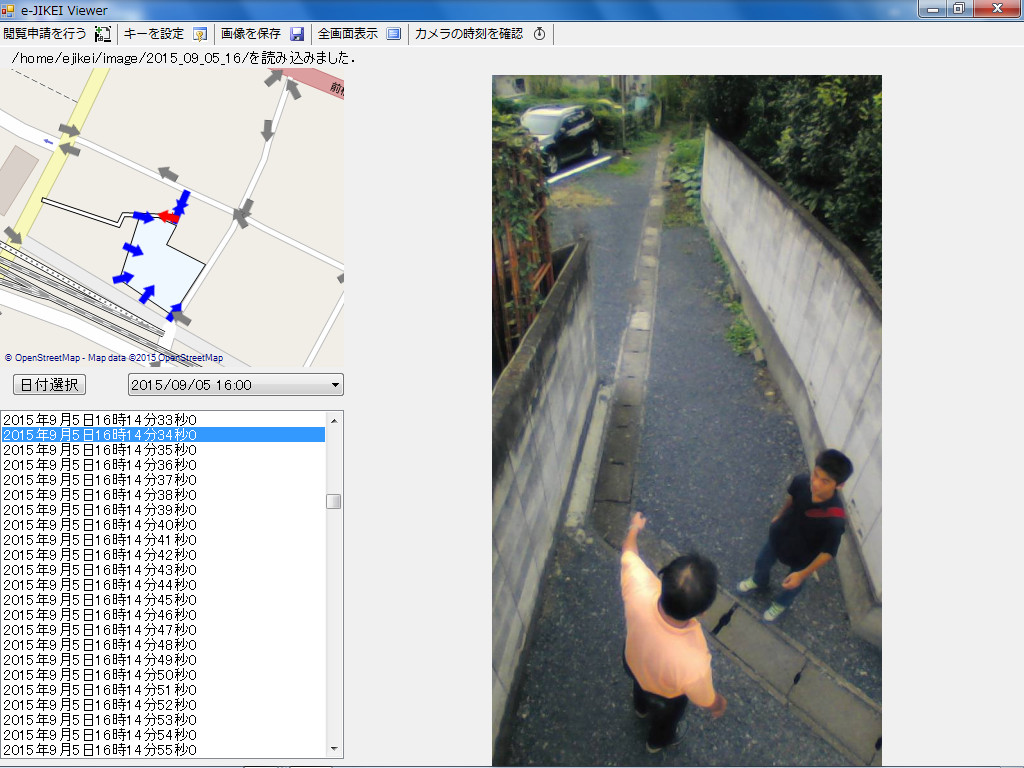
Demonstrations show, as sequences of screenshots from the viewing terminal, how a target is followed by switching cameras — and how the process of obtaining viewing permission from the recording server is published on the internet. There are two examples of good use and one of misuse:
Commercialisation: the "e-JIKEI Light", an LED security light with a built-in camera (2009 press release (PDF, Japanese)). The current product is the e-JIKEI Light, new model (TOSTEC Co., Ltd., Japanese). Building cameras into streetlights (security lights) with encrypted recording has already been realised as a product.
List of field-trial sites: e-JIKEI Net Camera field trials | Example: Suehiro Mirai Parking (Suehiro-cho, Kiryu City)
e-JIKEI Door-Phone social experiments with neighbourhood associations: list of social experiments (pages in Japanese)
Main papers
FMPS + VRAIO
- Y. Fujii, "Governing AI Outputs in a Fully Sensed Society: Is Output Governance Sufficient for Social Acceptance?", Smart Cities, Vol. 9, No. 10, Art. 167, 2026. Paper
- Y. Fujii, "No trust without trust infrastructure: The extended Kelvin principle and its application to AI output governance", AI, Vol. 7, No. 6, Art. 218, 2026. doi:10.3390/ai7060218
- Y. Fujii, "VRAIO as a safety valve: Governing AI platform outputs at societal scale", AI and Ethics, Vol. 6, Art. 340, 2026. doi:10.1007/s43681-026-01206-z
- Y. Fujii, "Verifiable record of AI output for privacy protection: Public space watched by AI-connected cameras as a target example", AI & Society, Vol. 40, pp. 3697–3706, 2025. doi:10.1007/s00146-024-02122-8
Earlier work
- Y. Fujii, N. Yoshiura and N. Ohta, "Creating a worldwide community security structure using individually maintained home computers: The e-JIKEI Network Project", Social Science Computer Review, Vol. 23, No. 2, pp. 250–258, 2005. doi:10.1177/0894439304273274
- Y. Fujii, K. Maru, K. Kobayashi, N. Yoshiura, N. Ohta, H. Ueda and P. Yupapin, "e-JIKEI Network using e-JIKEI Cameras: Community security using considerable number of cheap stand-alone cameras", Safety Science, Vol. 48, No. 7, pp. 921–925, 2010. doi:10.1016/j.ssci.2010.03.018
- Y. Fujii, N. Yoshiura, N. Ohta, A. Takita, H. Ueda and K. Maru, "Abuse Prevention of Street Camera Network by Browsing-History Disclosure", Journal of Community Informatics, Vol. 12, No. 1, pp. 152–156, 2016. doi:10.15353/joci.v12i1.3216
- Y. Fujii and N. Yoshiura, "Will every streetlight have network cameras in the near future?", Science, eLetter, 21 October 2016. eLetter
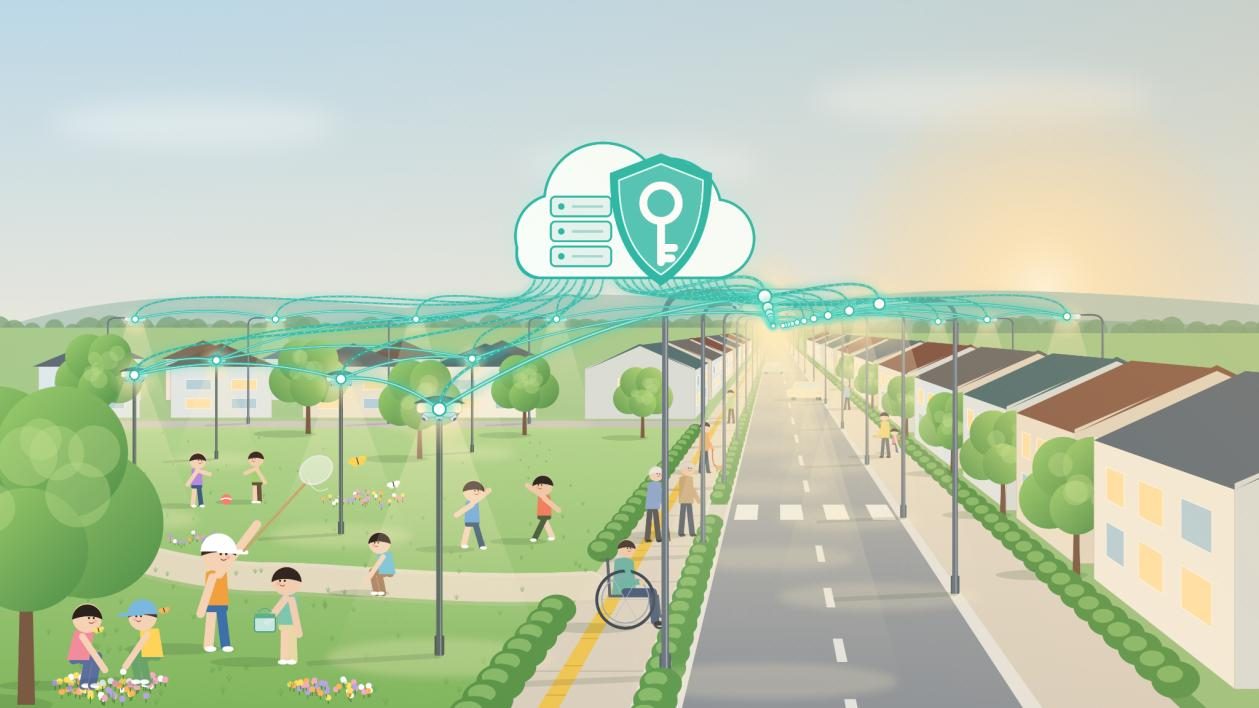
Dense coverage by streetlights
Funding
JSPS KAKENHI Grant-in-Aid for Challenging Research (Exploratory) 26K21972, "Reconstructing Ethical Principles and Developing Socio-Technical Infrastructure for Defending Democracy in the AGI Era"
Press release: English press release (PDF) | Japanese press release (Gunma University website)
← Previous: 10. FAQ | Next: 12. Contact →
Contents
FMPS + VRAIO: Public-safety infrastructure built on streetlights, and the governance of AI outputs | Yusaku Fujii (Gunma University) and NPO e-JIKEI Network Promotion Institute
This site presents a research-stage concept; all figures are estimates.