CHAPTER 6
VRAIO (Verifiable Record of AI Output) changes the way we think about protecting privacy: govern the output of information, rather than restricting measurement.
Security technologies such as encryption have advanced greatly against outside attacks. But misuse of information by insiders with legitimate authority remains a fundamental problem.
Much of the concern about privacy is not about being recorded as such, but the fear that recorded information will be used, without our knowledge, for improper purposes. If so, the critical point to protect is the exit through which information leaves the system.
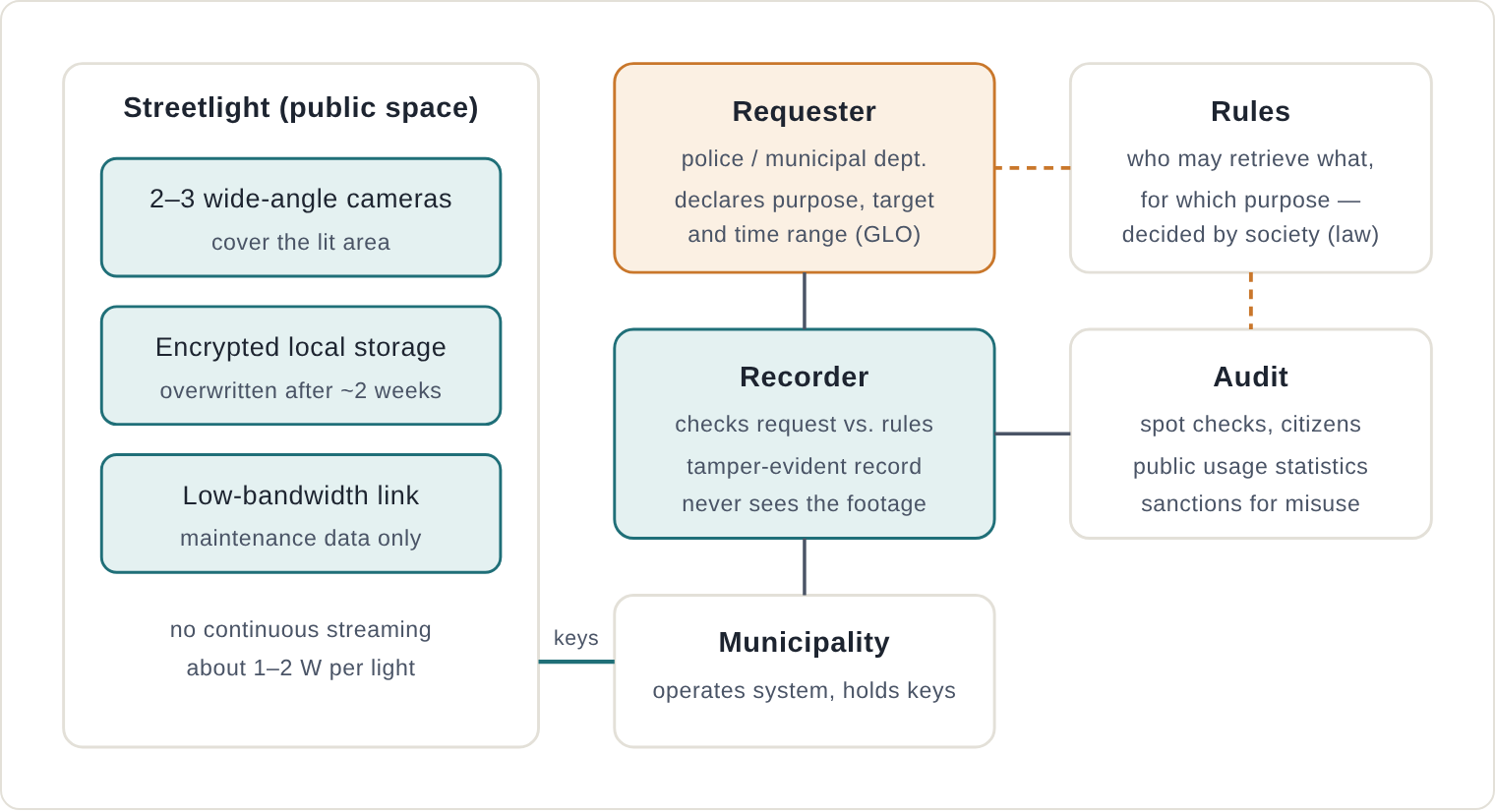
Figure: FMPS + VRAIO architecture. Footage is stored encrypted at each streetlight and can be retrieved only through a disclosure procedure recorded by the Recorder.
Surveillance cameras have so far relied on the goodwill of operators and compliance with guidelines. VRAIO builds, as a mechanism, a state in which misconduct is detectable and sanctioned. For honest operators, it is also a way to demonstrate their legitimacy.
The prototype of this idea has already been operated as a real system. In the e-JIKEI Net Camera field trials in Kiryu City, footage could not be viewed without permission from the recording server, and every viewing was made public (Chapter 11; Demo 3: Stalking by a city-hall employee (PDF)).
|
VRAIO does not decide the specific rules: who may retrieve what, whether a warrant is required, whether the person viewed is notified, how usage statistics are published. These are for society to decide through laws and ordinances. VRAIO is a mechanism that makes it possible to verify afterwards that the agreed rules were actually followed. |
Some feel reassured by low-quality cameras that cannot capture faces. In FMPS, however, image quality is set by what tracking and identification require; at key locations, faces and number plates are recorded clearly. Privacy is protected not by reducing measurement capability but by governing outputs. This is the core of VRAIO.
← Previous: 5. FMPS in Numbers | Next: 7. If a Government Tried to Misuse It →
FMPS + VRAIO: Public-safety infrastructure built on streetlights, and the governance of AI outputs | Yusaku Fujii (Gunma University) and NPO e-JIKEI Network Promotion Institute
This site presents a research-stage concept; all figures are estimates.