日本語
This is a research-stage concept. A prototype was operated in field trials in Kiryu City, Japan; the integrated system at streetlight scale has not yet been built and will be tested in pilot demonstrations.
Streets where children can play outside safely —
starting from the streetlights.
FMPS (Fully Monitored Public Space) is a concept for public-safety infrastructure: inexpensive cameras built into existing streetlights, so that people's movements in public space can be followed without gaps. Privacy is protected not by restricting measurement but by governing how information is released, through VRAIO (Verifiable Record of AI Output).
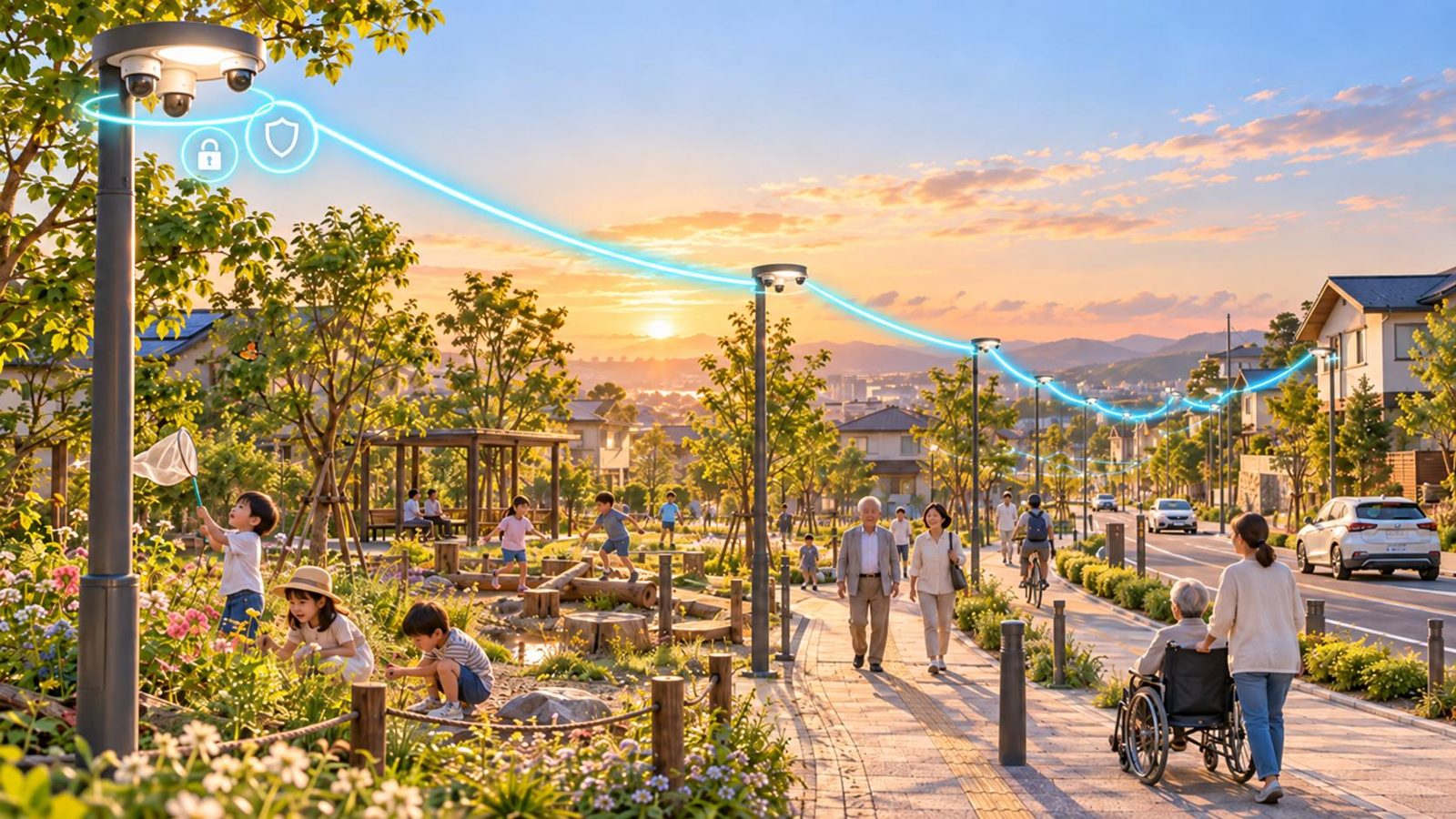
The public space FMPS aims for
Key points
- If routes are covered in public space, a person's movement never breaks off. Everything outside public space is private property, so if a person disappears, we know which property they entered.
- Streetlights already cover public space. All that is needed is to add inexpensive, smartphone-grade parts.
- Footage is not streamed. It is stored encrypted at each streetlight, and only when an incident or a disappearance occurs are the necessary few seconds retrieved, camera by camera.
- Technology and cost are no longer the barrier. The largest remaining barrier is concern about privacy.
- VRAIO directly addresses what that concern is really about: misuse of information. An independent Recorder records who retrieved what, and for what purpose, and every retrieval is subject to audit and sanctions.
| About 1–2 W | Power per streetlight (estimate, three cameras) |
| About US$100 | Electronic parts per unit (smartphone-grade components) |
| About 100 MB | Data needed to trace one missing child over about 1 km |
The figures are estimates. Assumptions and calculations are in 5. FMPS in Numbers.
Where to start
- For residents: What if one day your child does not come home? A concrete example of what FMPS does — and does not do. Then read Chapters 6 and 7.
- For local governments and police: How it works, the numbers, phased introduction, and operation. See Chapters 4, 5, 8 and 9.
- For companies: Lighting, cameras, telecommunications, AI, security, maintenance and auditing — for those considering joining a new public-infrastructure industry.
Contents
- 1. What Is FMPS?: The basic principle of FMPS and how it differs from conventional security cameras
- 2. A Child Does Not Come Home: A step-by-step example of how FMPS + VRAIO works in the search for a missing child
- 3. Why Now?: Ungoverned surveillance is already spreading — and the Extended Kelvin Principle
- 4. How It Works: Unit configuration, recording and retrieval, the coverage concept, and encryption
- 5. FMPS in Numbers: Estimates of power, storage, data volume and cost, and their assumptions
- 6. VRAIO: Governing Outputs: Govern the output of information rather than restricting measurement — how VRAIO is structured and works
- 7. If a Government Tried to Misuse It: Answering the strongest objection head-on: protection by structure, not only by rules
- 8. Uses and Phased Introduction: Uses such as watching over children, after-the-fact tracking and anomaly detection, and how to run pilots
- 9. What It Means for Stakeholders: FMPS + VRAIO for residents, municipalities, police and companies; legal basis and cost sharing
- 10. FAQ: Common questions about FMPS + VRAIO, and answers
- 11. Research History: Over 20 years of research, from the e-JIKEI Network concept of 2002 to FMPS + VRAIO
- 12. Contact: Contact details for enquiries about FMPS + VRAIO
Next: 1. What Is FMPS? →
FMPS + VRAIO: Public-safety infrastructure built on streetlights, and the governance of AI outputs | Yusaku Fujii (Gunma University) and NPO e-JIKEI Network Promotion Institute
This site presents a research-stage concept; all figures are estimates.