CHAPTER 4
An FMPS unit is like a smartphone mounted on a streetlight. No special new technology is needed; it is built from existing components and standard technologies.
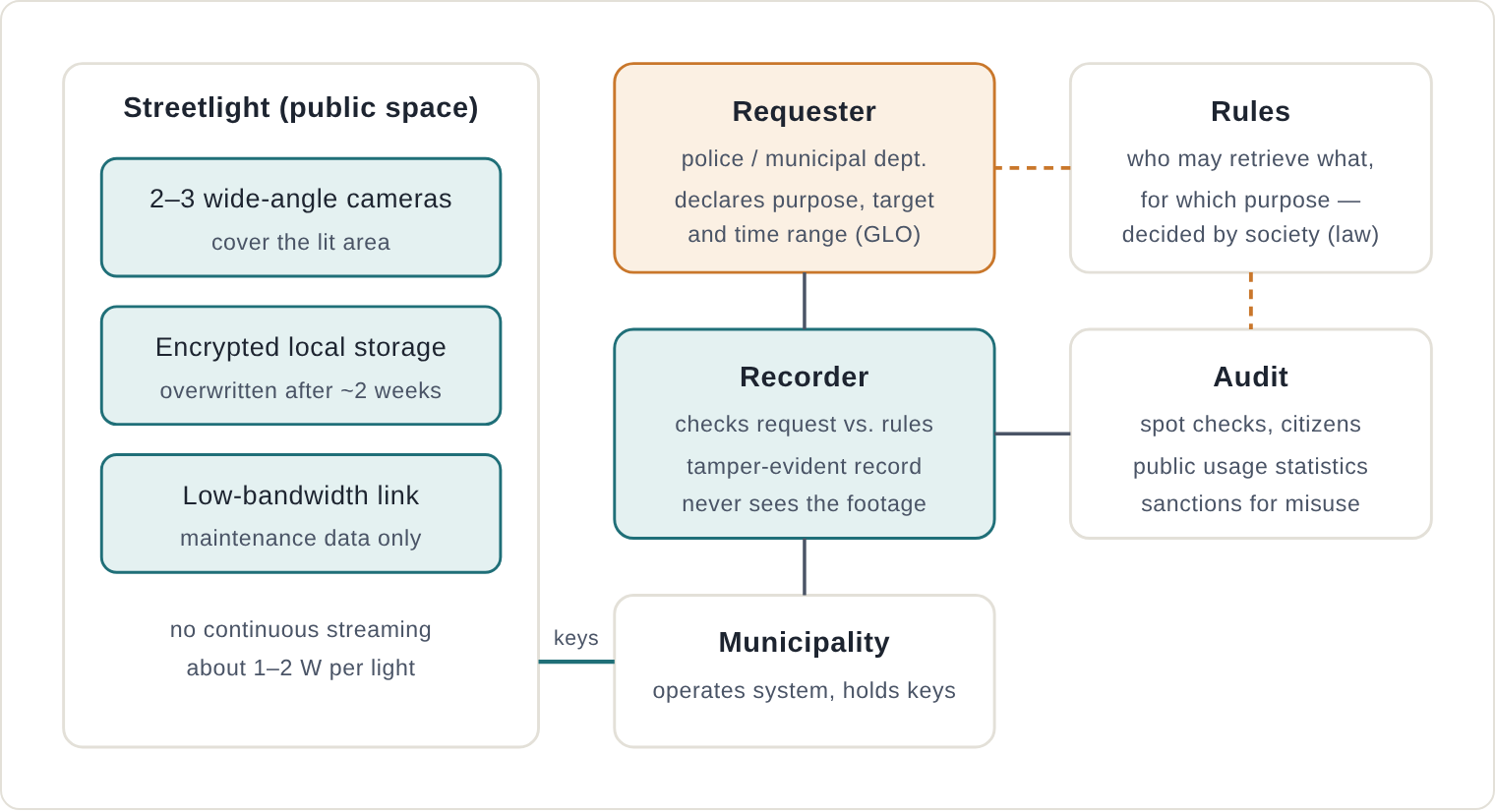
Figure: FMPS + VRAIO architecture. Footage is stored encrypted at each streetlight and can be retrieved only through a disclosure procedure recorded by the Recorder.
Building a camera into a streetlight and storing the footage encrypted inside the luminaire has already been commercialised: the "e-JIKEI Light", jointly developed in 2009 by Gunma University, the NPO e-JIKEI Network Promotion Institute, TOSTEC Co., Ltd. and ROCKY Co., Ltd. (2009 press release (PDF, Japanese)). TOSTEC now sells a second-generation model (e-JIKEI Light, new model (TOSTEC Co., Ltd., Japanese)). FMPS extends this into a network covering the whole town, and governs retrieval with VRAIO.
In normal times images of about 20 kB each are recorded; when motion is detected, images of about 100 kB; a few per second. In quiet hours only small images are stored, which keeps the data volume low.
Footage is retrieved only when an incident or disappearance occurs, and only as much as is needed.
Only images from the necessary cameras in the necessary time windows are retrieved. This keeps data volumes small and allows each viewed image to be recorded individually, making detailed audits possible.
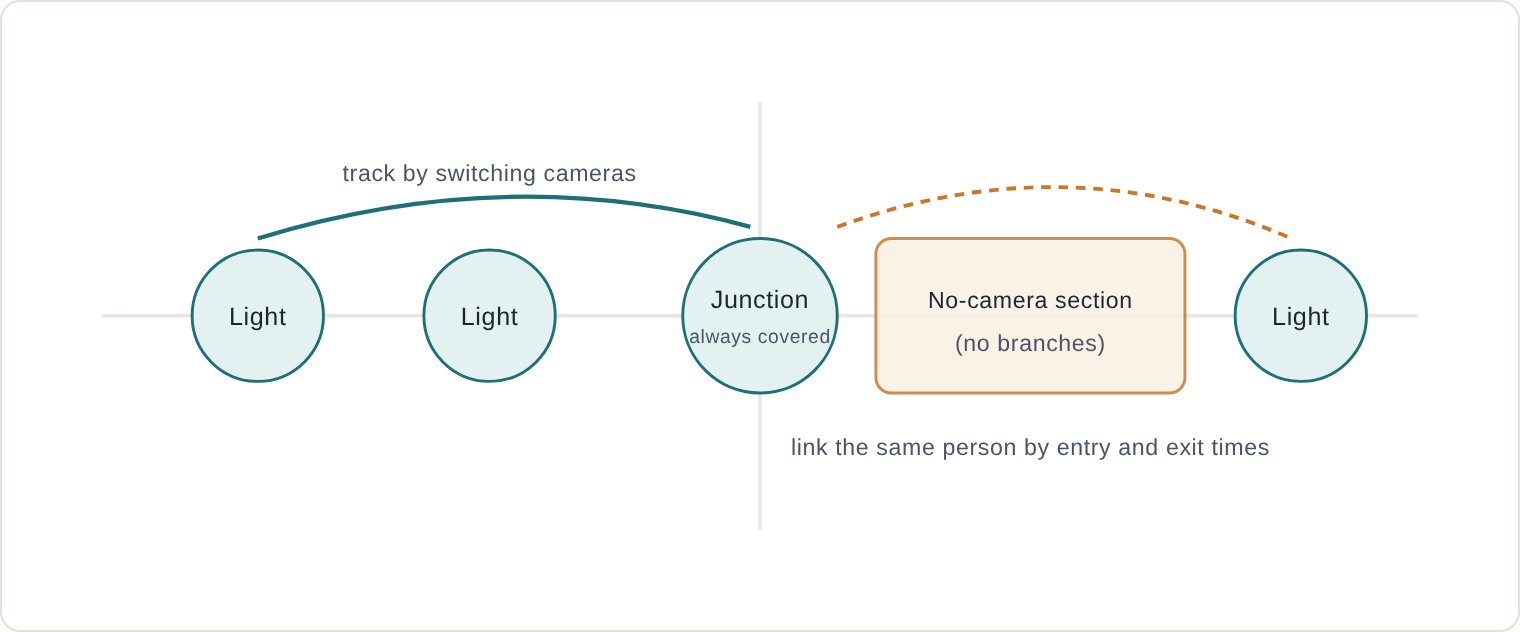
Figure: Continuous coverage of every point is not required. If the entrances and exits of camera-free sections (especially junctions) are covered, a person's route can be linked by time.
Tracking does not require every point to be covered without gaps. What it requires is covering the entrances and exits of sections without cameras, especially junctions and branch points. On a road without branches, if a person disappears at one point and appears at another, the two can be linked as the same person by time.
Japanese residential areas have almost no completely dark alleys, and any that exist are very little used. If a person enters a large area such as a park or riverbank and does not come out, the search is narrowed to that area. A break in the trail is not a failure of tracking; it defines the search area.
Repairing units on top of streetlights every time one fails would be a heavy burden. FMPS is designed, through overlapping fields of view, to keep functioning as a whole even if more than one in ten units has failed. Software updates automatically, and units that stop are restarted automatically. The main technical challenge is protection against weather, especially direct sunlight and high temperatures.
Images are encrypted inside the unit. Removing the memory card does not make its contents readable. Decryption is possible only through the disclosure procedure recorded by VRAIO. Changes in camera direction, covering and removal are detected and reported over the maintenance link. All of this can be handled with existing, standard encryption and security technologies; no new technology is required.
Linking a route from camera to camera requires the clocks of all units to agree. This can be achieved with satellite positioning or time synchronisation over the network.
← Previous: 3. Why Now? | Next: 5. FMPS in Numbers →
FMPS + VRAIO: Public-safety infrastructure built on streetlights, and the governance of AI outputs | Yusaku Fujii (Gunma University) and NPO e-JIKEI Network Promotion Institute
This site presents a research-stage concept; all figures are estimates.