日本語
This is research-stage work. Prototypes have been validated with mannequins and breathing simulators; studies with human participants and community field trials are still to come.
Measures for the Next Pandemic
Getting through the next pandemic without shutting society down.
During COVID-19, the main tools for controlling infection were restrictions on movement and lockdowns. This research builds another option: purifying the air each person breathes, so that inhalation of infectious aerosols is itself reduced (PAPR for Everyone); and making the high-resolution measurement that supports it socially possible while protecting privacy (privacy infrastructure).
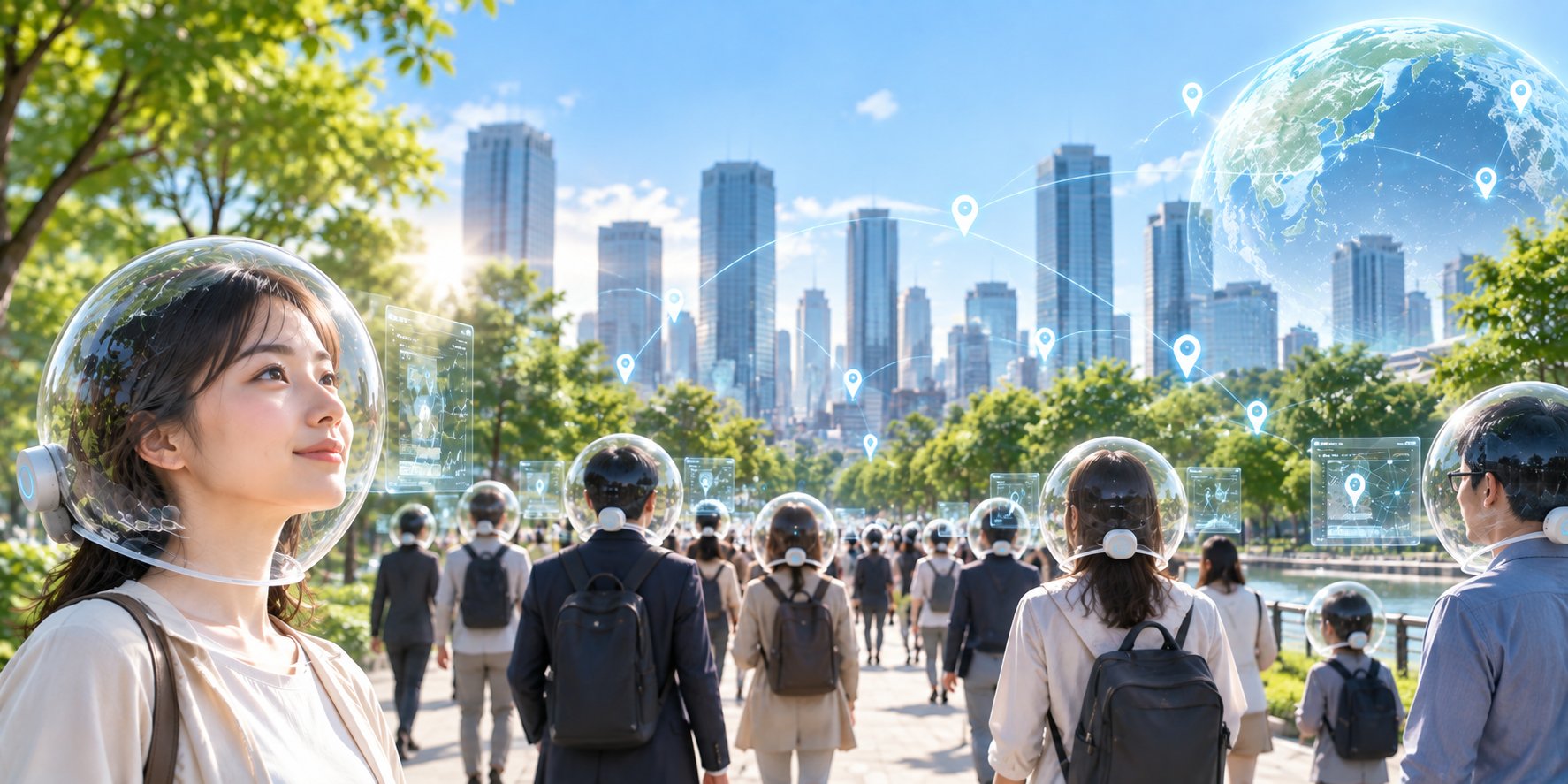
The city that PAPR for Everyone envisions for the next pandemic (illustration)
Key points
- Stop the inhaled exposure, not society. A positive-pressure powered air-purifying respirator (PAPR) continuously supplies HEPA-filtered air to the breathing zone and keeps outside air from leaking in. It acts on a physical step that precedes infection, so it does not depend on the pathogen.
- Make it affordable and wearable for everyone. The main parts are a filter, a pump and a battery; the parts for a laboratory prototype cost about US$40.
- Make it measurable. A single differential-pressure sensor estimates whether the device is worn, respiratory flow and mask leakage, and reports them to a smartphone.
- Do not require constant wear. A time-managed scheme (PWS-NET) gives each person an allowance of mask-off time, balancing infection control and personal freedom.
- Measurement rests on trust. COVID-19 was also a "measurement failure". VRAIO, which makes the release of information verifiably governable, turns privacy protection from a constraint on measurement into its precondition.
- Next comes evaluation. Six years after the 2020 proposal, built up through peer-reviewed papers and patents, the work proposed in 2026 that this approach become a formal subject of public health evaluation.
| APF 1000 | Assigned protection factor of positive-pressure (hood/helmet) PAPRs: under specified conditions, inhaled aerosol concentration about 1/1000 of ambient (medical masks: APF 10) |
| About 55% | Share of the population wearing PAPRs continuously needed to bring Rt from 2 to 0.9 (model calculation, ideal supply-side shielding) |
| About US$40 | Parts cost of the low-cost laboratory prototype |
| 3 | Granted PAPR-related patents (Japan) |
Assumptions and sources are given in each chapter.
Where to start
Contents
- 1. What Is PAPR for Everyone: Bringing positive-pressure respiratory protection to infection control for the general public
- 2. Six Years Since 2020: From concept to prototype, models, sensing and operation, one paper at a time, and onto the public health agenda
- 3. Feasibility and Requirements: Can a PAPR for the general public be built, and how many people must wear one to control an epidemic?
- 4. Measuring Breathing and Leaks: Estimating wear, breathing and leakage from a differential-pressure sensor and pump control signals
- 5. Time-Managed Use: PWS-NET: networked management of wearing status, balancing infection control and personal freedom
- 6. Toward Formal Evaluation: Evaluating positive-pressure exposure control for the public as a candidate intervention in pandemic preparedness plans
- 7. Privacy Infrastructure: Privacy protection as the precondition, not the constraint, for high-resolution infectious-disease measurement
- 8. Govern, Measure, Protect: Govern, measure and protect: from uniform restrictions to precision intervention
- 9. Papers, Patents and Funding: Peer-reviewed papers (with links), related patents and research funding
- 10. Contact: Contact for research, media and collaboration
Related site: FMPS + VRAIO: public-safety infrastructure built on streetlights
Next: 1. What Is PAPR for Everyone →
Measures for the Next Pandemic: engineering and social infrastructure for controlling infection without stopping society | Yusaku Fujii (Gunma University)
This site presents research-stage work; figures are model calculations or prototype measurements.