CHAPTER 2
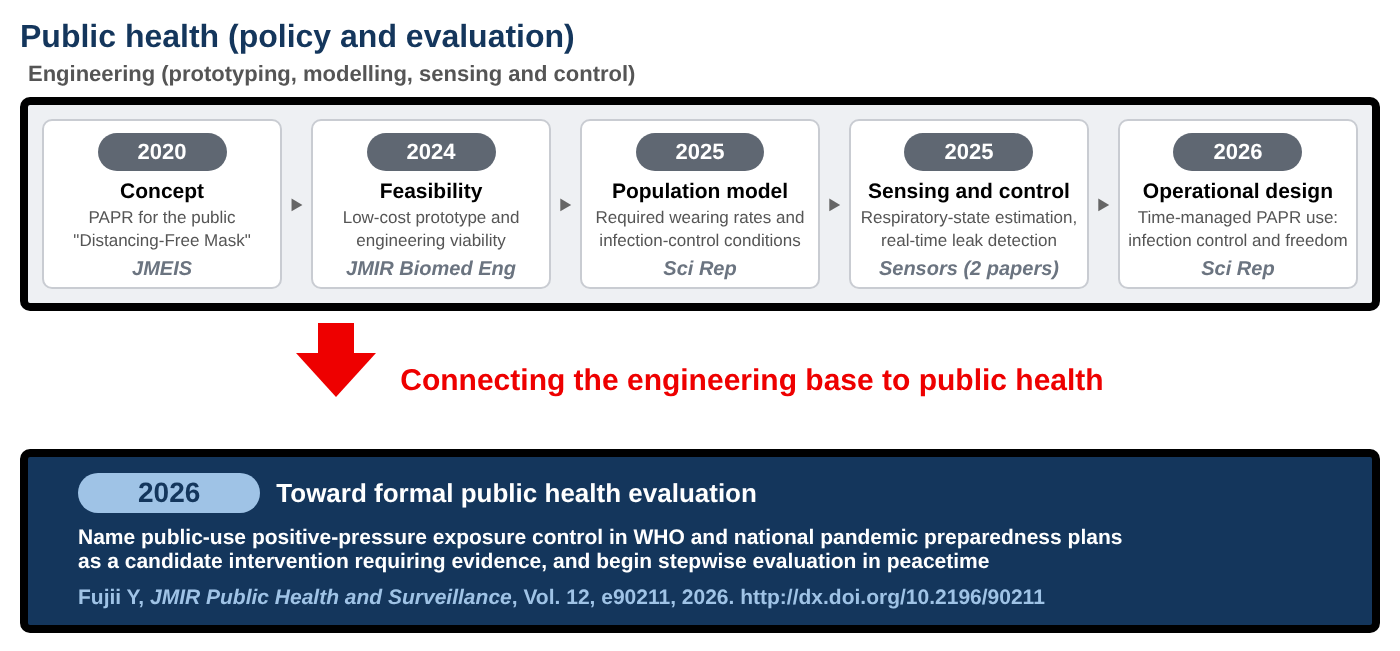
Figure: PAPR for Everyone, from the 2020 proposal to the call for formal public health evaluation
| When | What |
|---|---|
| 7 July 2020 | First press announcement of the “Distancing-Free Mask” concept, widely covered by newspapers and television |
| 2020 | Concept paper (JMEIS): the helmet-type “Distancing-Free Mask” |
| October 2021 | Basic studies begin under JSPS KAKENHI, Fostering Joint International Research (B) (to March 2025) |
| 2024 | Feasibility study (JMIR Biomedical Engineering); Japanese Patent No. 7515044 granted |
| January 2025 | Population-level requirements (Scientific Reports); Japanese Patent No. 7616624 granted |
| March 2025 | Japanese Patent No. 7653735 granted |
| April 2025 | JSPS KAKENHI Grant-in-Aid for Scientific Research (B) 25K00735 awarded (to March 2028); work moves towards practical use |
| 2025 | Respiratory-state estimation and real-time flow/leak estimation (two Sensors papers); research plan (Japanese Journal of Social Safety and Privacy) |
| 2026 | Time-managed use, PWS-NET (Scientific Reports) |
| 27 August 2026 | Call for formal public health evaluation (JMIR Public Health and Surveillance) |
| 5 October 2026 | Measurement failure and privacy infrastructure (Journal of Medical Internet Research) |
When I proposed this concept on 7 July 2020, early in the pandemic, the basic idea of PAPR for Everyone seemed to me extremely simple, almost self-evident.
If there is a risk of airborne infection, then besides stopping people's activities there should also be the option of purifying the air each person breathes. If it is technically possible, society should use it. At first I thought that showing the possibility would be enough to move things forward.
Reality was not so simple. There is a wide gap between what is plausible in engineering terms and what can be adopted as a public health measure. And before that, the concept itself had to be understood and taken up for consideration.
So I broke the question down, one piece at a time: can a PAPR for the general public really be built; how much performance is needed; can breathing and leakage be measured; is there a realistic way to operate it. Each answer was published as a peer-reviewed paper.
We are not yet at a point where we can say scientifically that PAPR for Everyone should be adopted. But surely we have moved past debating whether it is even worth considering.
How far can it reduce infection risk? Under what conditions could society use it? Is it cost-effective? Will people accept it? These are not questions to settle by debate alone. They are questions to measure, compare and test.
Now it is time to test it.
(Yusaku Fujii)
← Previous: 1. What Is PAPR for Everyone | Next: 3. Feasibility and Requirements →
Measures for the Next Pandemic: engineering and social infrastructure for controlling infection without stopping society | Yusaku Fujii (Gunma University)
This site presents research-stage work; figures are model calculations or prototype measurements.